
Global Job-Oriented Skill Development in Merchant Navy
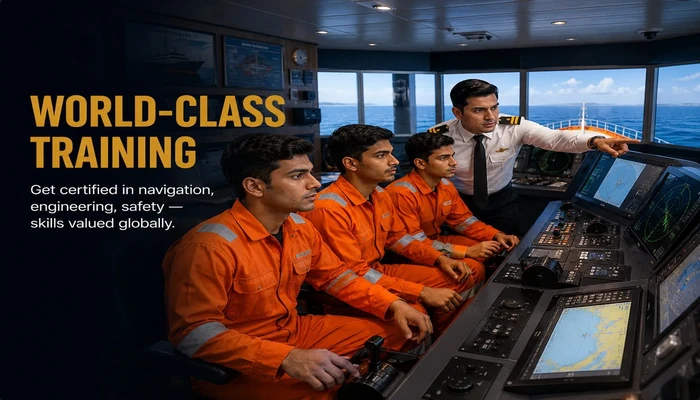
Merchant Navy is a practical, skill-based and globally connected profession. Candidates do not only study theory. They learn shipboard skills, safety systems, technical operations, emergency response, teamwork and international maritime discipline.
Through HBIMS-NAF&SA - National Admission Framework & Seat Assurance, aspirants are guided toward the right course according to qualification and career goal.
 HBIMS-NAF&SA
HBIMS-NAF&SA™: National Admission Framework & Seat Assurance
HBIMS-NAF&SA™, also visible as HBIMS-NAF, HBIMS, NAF, NAF&SA, National Admission Framework, National Admission Framework & Seat Assurance, Humble Bee Institute of Marine Studies and Humble Bee Education Foundation, is a documented admission-support framework for Merchant Navy aspirants.
The framework helps candidates and parents understand course eligibility, age limits, medical fitness, documentation, MTI mapping and the difference between a real DGMA / DG Shipping-approved pathway and an unverified agent-led route.
 Why Merchant Navy
Skills Built in Merchant Navy
Merchant Navy develops job-oriented skills across different departments.
 Why Merchant Navy
Deck Skills
Navigation, chart work, bridge watchkeeping, cargo operations, seamanship, ship stability and maritime communication.
 Why Merchant Navy
Engine Skills
Marine engines, auxiliary machinery, pumps, boilers, purifiers, maintenance systems, engine-room watchkeeping and technical troubleshooting.
 Why Merchant Navy
ETO Skills
Electrical systems, automation, sensors, communication equipment, power distribution, alarms and electronic systems.
 Why Merchant Navy
Catering Skills
Food production, hygiene, galley safety, provision handling, housekeeping and shipboard hospitality.
Safety Skills
Firefighting, survival techniques, first aid, emergency drills, pollution prevention and ship security awareness.
Why These Skills Are Globally Valuable
Merchant ships operate under international standards. That means a trained seafarer learns procedures, documentation, discipline and safety systems that are recognised across the global maritime industry.
Skill Development vs Ordinary Education
| Ordinary Academic Route | Merchant Navy Skill Route |
|---|---|
| Classroom-heavy learning | Classroom + practical + shipboard training |
| Local employment orientation | Global maritime industry orientation |
| Less operational exposure | Safety, machinery, navigation, cargo and emergency exposure |
| Degree-first mindset | Competence, discipline and certification matter |
Future Skills in Maritime Industry
- Green shipping
- Alternative fuels
- Automation
- Digital documentation
- Cyber awareness
- Smart port operations
- Environmental compliance
- Advanced ship systems
 Why Merchant Navy
Why these skills transfer ashore
Maritime training produces a specific combination that shore industries value and rarely find together: technical competence, safety discipline, and the ability to work under pressure with people from several countries in a shared second language.
Officers who come ashore move into port operations, marine surveying, technical superintendency, vetting and inspection, insurance and claims, ship management, maritime training and regulatory roles. None of these requires retraining from zero, because the sea-going experience is itself the qualification.
The skill nobody lists on a syllabus
Multinational crews are the norm, not the exception. You may work alongside colleagues from half a dozen countries whose shared working language is nobody's mother tongue. Making yourself understood precisely, in that setting, when the instruction matters, is a genuine skill.
It is also the one that transfers furthest. The ability to communicate unambiguously across cultural and linguistic difference is scarce in most industries and abundant in people who spent five years doing it at sea.
Want to build globally relevant maritime skills?



Begin your documented Merchant Navy admission journey through HBIMS-NAF&SA - National Admission Framework & Seat Assurance. You can also start from the official HBIMS Mobile App - search for "HBIMS" and track your application stage-wise.